Search This Blog

Showing posts with label college. Show all posts

28 May 2014

So you want to make a portfolio from your pictures?

Smiles from Infinity
Recent work on my self-marketing package included producing a printed portfolio. Simple enough; I have some four thousand archived images to choose from. Some of them have to be good, if not spectacular. As it turned out, I took a lot of really good, even exceptional, pictures over the years.
So, how do I choose what will represent my style? Well, I had to sort, sort those that I sorted, and sort those again ruthlessly. 
Here's how I start my sorting:
First sort: Pull together images that speak to me in some way. Since I'm in my Archive, I've already weeded out poor, such as out of focus or badly exposed, images and those that were too marginal to fix.
Cloud Crown on a Hill
Second sort: Group images by type, such as landscapes, portraits, architecture, street scenes, and so on. Don't forget to include personal projects, as they can really reflect your style. Reject any orphans. Some images can work in multiple categories, and that's good. They make ideal transitions between portfolio sections. Some, like the cuties above, make the front cover.
Third sort: Look at each image as if it wasn't your work. Blow it up on the screen. Do a test print if you have any doubts. Reject any that become blotchy, have cluttered backgrounds or noise you just can't get rid of.
Fourth sort: Arrange your images into logical groupings. Look for repeats of the same thing, be it model, scene or general type. Do two images look similar enough to be confused for each other when viewed at a distance? If yes, remove one of them as you essentially repeated a picture.
Doorway Silhouette 
After all that, I ran the ones I picked past a trusted friend who would tell me the truth for a final sorting. 
Sometimes, it's worth the time and money to go to a personal portfolio review for a sorting by a professional art director or buyer. They really have seen the gauntlet from "Oh. My. Goodness. Where have you been?" to "Oh my goodness, please take this away." And everything in between. They can give you valuable advice as to what a good picture is, and how you can improve the way you present yourself through your images.
Now, you have something worth publishing. I set up my portfolio using MagCloud because they weren't expensive, their color matching is very good, and they could turn around an order in a fairly short time (about a week). They have a template that I used in InDesign to lay out the covers and the pages that works very well with one minor exception: the inside (towards the binding) margins on the first and last sheets inside the cover are very tight. This is a legacy of the perfect (glue) binding process. While I didn't have text cut off, I still had to move text in a bit to re-balance the margins. 
Colors of a Midway
(HP recently sold MagCloud to Blurb, so I'm inclined to get my redoes and alternate editions done sooner rather than later while the quality control at MagCloud is still in place. We'll have to see how well the color control holds up as the two become fully merged.) 
One thing I did have to do is lighten most of my pictures a touch. As good as my monitors are calibrated, images displayed on my monitors are still lighter than they'll appear in print. Lighten accordingly. Use test prints to double check.
Before sending off your baby, print spreads of facing pages. Look for unfortunate groupings or combinations, make sure your progression through each section, as well as the order of the sections, make logical sense. Adjust. Reprint. Look again. Keep doing it until you are happy with the way it flows.
Are you hoping to market your work to architectural firms? Don't lead with a section of portraiture. Travel? Get your beautiful city-scapes up front! If you are indeed marketing to different groups, then it's worth your while to have separate editions of your portfolio for each one emphasizing that subject. They really aren't that expensive to produce (less than $20 each for mine, and that included postage).
That's it in a nut shell. I hope to be wowed by your book of images in the near future.
All images above are under the copyright of W. Clinton Hotaling. Do not republish the images without written permission.

22 January 2014

Working with Models or Talent

Stephanie and my Hat
In still photography, they're models. In motion imagery, they are talent. In either case, they are the people (and sometimes animals) you put in front of your lens to help you tell your story. They are also a big factor in your collaborative effort to deliver a product for your client.

Sometimes the hardest part of the whole process is simply finding the model or talent that you need. Most beginning photographers and videographers recruit from their circle of friends and family. My most reliable model is my lovely wife. She'll complain, but she models very well. College acting classes, small local agencies as well as nationally connected talent bureaus all are sources for recruiting that person that will work in front of your lens. It's just a matter of how much time and budget you have.

The first step in making sure you have what you need is to ask very specifically for what you are looking for: approximate age, gender, hair color, facial hair (men), hair length, height, body build, secondary talent (dance, singing, horsemanship, etc.), and/or anything else that would be what you have in mind for your imagery. Also, be specific in what type of role this person would play. For instance: "Physical comedy as an always ready to please, clumsy husband for a competent, but indulgent wife." Hopefully, from your listing you'll get a set of people willing to audition for you.

Quite often, with models for still work the selection process gets done through head shots, resumes, portfolios and availability checks. Motion talent usually must be "tested" to see how well they fit the ideal  for your project. (Benedict Cumberbach was the only one tested for the role of Holmes in "Sherlock". Martin Freeman was one of many who were tested for the role of Watson, but the instant chemistry between him and Cumberbach during Freeman's test cemented the role for him.)

Hannah: "This is awkward!"
Make sure that responsibility for secondary items like wardrobe, hair styling and makeup are clearly spelled out before your talent arrives on the set or studio. Almost always, you are responsible for any props or products, but these other considerations, if fairly basic, can be covered by your talent. (They should tell you if they don't have something specific that you asked them to bring, i.e. ripped jeans. If that's the case you will need to supply it for them. Be sure to get the correct size. Whether they keep what you supply them is up to you.)

Once your talent is decided, make sure they understand exactly what you want them to do. They are quite willing to do so if they know what you are after. For a commercial I shot, an actor deliberately fumbled the large assortment of tools he was holding. It was marvelously fake, and you could see that it was fake on the recording. I explained to him that the many items in his hands will naturally fumble when he selects just one to use, just let them do so. It looked much better (and was funnier) when he relaxed and just let the pieces fall.

How tight of control you use is up to you. I tend to be more collaborative, and only correct or re-do when something didn't work. Annoyingly for the talent, that might be something other than what the talent did. I've been known to retake a scene for minor corrections (see above), but I do enjoy letting my talent run with an idea.

Don't forget to make sure the appropriate releases are signed.

One last thing. Most models or talent are part-timers in this. Be sure to feed them.

28 September 2012

Bringing Things Together

Edgewood Park and Pleasure Drive
A friend reminded me of some basic things that need constant, well, nagging: Practice, balance, responsibility and caring. I am notorious for being scattered, impulsive, often absent-minded, and usually procrastinating chores. However,...well, my accomplishments will have to wait for later.

There are times when a rather ephemeral idea keeps showing up in my head, and it's a good one, making me excited about it. The problem is the connections that led to that idea are fragile at best, so keeping that idea in mind isn't easy. What made it easier is a mild setback with my left knee.

As many of you know already, I've been fighting sciatica in my left leg, caused by a bulging disk in my lower spine and osteoarthritis in both knees. My recent weight loss has taken a lot of stress off of my joints, but the damage is done for my knees. Last October, my left knee "loosened" (my word, but it accurately describes the action) in the middle of a fencing bout and caused me to seek Urgent Care and physical therapy. The good news is that my knee should heal at least as good as it was last summer. The bad news is that I am more dependent on a cane for walking until the knee heals. I also have a lovely 20-30 minute twice-a-day (not counting swim work) exercise routine to rebuild the muscles around my knees and tighten up the joint. I also can't sit/stand/walk for more than a half hour before requiring a change in state. At least that gives me an excuse to refill my coffee or water while at the computer.

That was ten months ago.

The real joy is that the culprits are the cartilage pads (meniscus, menisci?) in my knees. They are best described as tattered. Beyond healing on their own. Come November, my left knee will be changed over to metal parts. The right knee, which was the bad one, should cruise on for years with a better leg to stand on the other side. With diligent physical therapy, I should be mostly restored to a pretty much normal life by early in the new year.

Meanwhile, I'm exploring more with my photography aided by new toy: the Pentax K-01. It's the less expensive mirror-less version of the K-5 I've been lusting after the last couple years. I'm having a lot of fun learning its quirks and how to manage my old (and the new two) lenses with it.


My lovely bride
Mattias and Seonag
The new tool is part of an experiment in portraiture. On the go: a 10x10 portable shelter, LOTS of blankets, even more spring clamps, a couple sheepskins, a couple stools, a bench and a handful of CFL and LED spot lights and a knowledge of stage lighting and away I went to two camping events photographing and printing portraits on site. I've yet to make back my investment, but this has proved interesting and fun!

Now that I'm taking portraiture at Edgewood College, I've already started to refine my techniques and strategies. I just need to keep developing my stable of models....

More next month. I promise!

03 May 2011

The Nature of Business

I have a day job, since I'm just getting started in the photography business and still need to eat and keep a roof over my head. We can't afford to live on just my or my wife's income by themselves, so I need to keep working there. I'm also realistic about my expectations; my wife even more so. I like to dream a bit (and spend money on what she calls "toys"), while she reigns in my fantasies with conditions for making the purchases. There's a little friction here, but this arrangement keeps our debts manageable.
For example: While I'm well aware that good photography is 95% the photographer and 5% the equipment, I do want to upgrade my camera with the idea of getting the ability to compete or simply having the respect of my clients. I have a perfectly respectable film SLR camera, which is great for art photography, and I have usable digital cameras that can cover about 90% of the situations I envision using a camera. The problem with the film camera is turnaround time for the clients, something that digital processes have shortened considerably. Turnaround time for film was made worse by the dearth of local film processors in my area. I can still get them done, but not the same day anymore. My old processor now takes a week or more just to bring me back the negatives! For my own projects that isn't an issue since I take time to scan the negatives and manipulate them as I need to, and I seldom have hard deadlines for my own projects. Most clients aren't willing to wait a week for the finished product, much less proofs.
The DSLR in question will run me $1400-$1700, and that's just the body. I can get a lower quality one for around $900 (It's the immediate predecessor.), but the upgraded one shows more longevity in usability. Also with a good unit, I'll be able to turn around projects often the same or next day for a client. I can even shoot high definition video. Fortunately, I have a good set of lenses that will fit this body, which suit my style of shooting. (I prefer manual focus over autofocus because I've found the autofocus will often enough home in on something that isn't my subject. It's one less thing to fight.)  Having the lenses already will save me more money than the camera itself in the long run. Most professionals will say, "It's a good investment, why haven't you bought it already?"
Good question. The answer is the condition for purchase compromised between me and my wife: I must have a job in the photography field or I need it for a class. And I'd better REALLY need it for that class. Understand that we're self-financing this business plan, and any money I spend is to be relevant in the moment. So, it's good that my wife keeps me in check. Less debt and fewer expensive dust collecters that way.
So, back to the day job. Needless to say, it isn't as a photographer, photographer's assistant, nor photojournalist. Like most creative types (I do include myself in that select group.), I chafe a bit from time to time working for a corporation even though I own stock in that corporation. The stress is getting worse lately, with communication conflicts with my supervisor and staff reductions and added responsibilities. I understand that a great many companies are having to work this way, but with customer service oriented businesses like retail stores, you need enough people to be there for the customers, not just physically but without distractions as well. I can go on and on about balancing the needs of your customers with the abilities of your employees and the profits your executives and investors make, but I don't have time to write that tome.
Let's just say that the stress is giving me impetus to jump-start my own business.
I also realize that working as a photographer can be a difficult way to make not very much money. Ah, but there is the satisfaction of the well-crafted image. There is also the coolness factor of the positive feedback when I show my product. That helps pay my emotional bank account. I know I'll never be financially wealthy, but the riches of a good body of work, and the satisfaction of creation goes a long, long way.
For a while at least, I'll keep the day job. When business picks up, I'll go to part time with it.
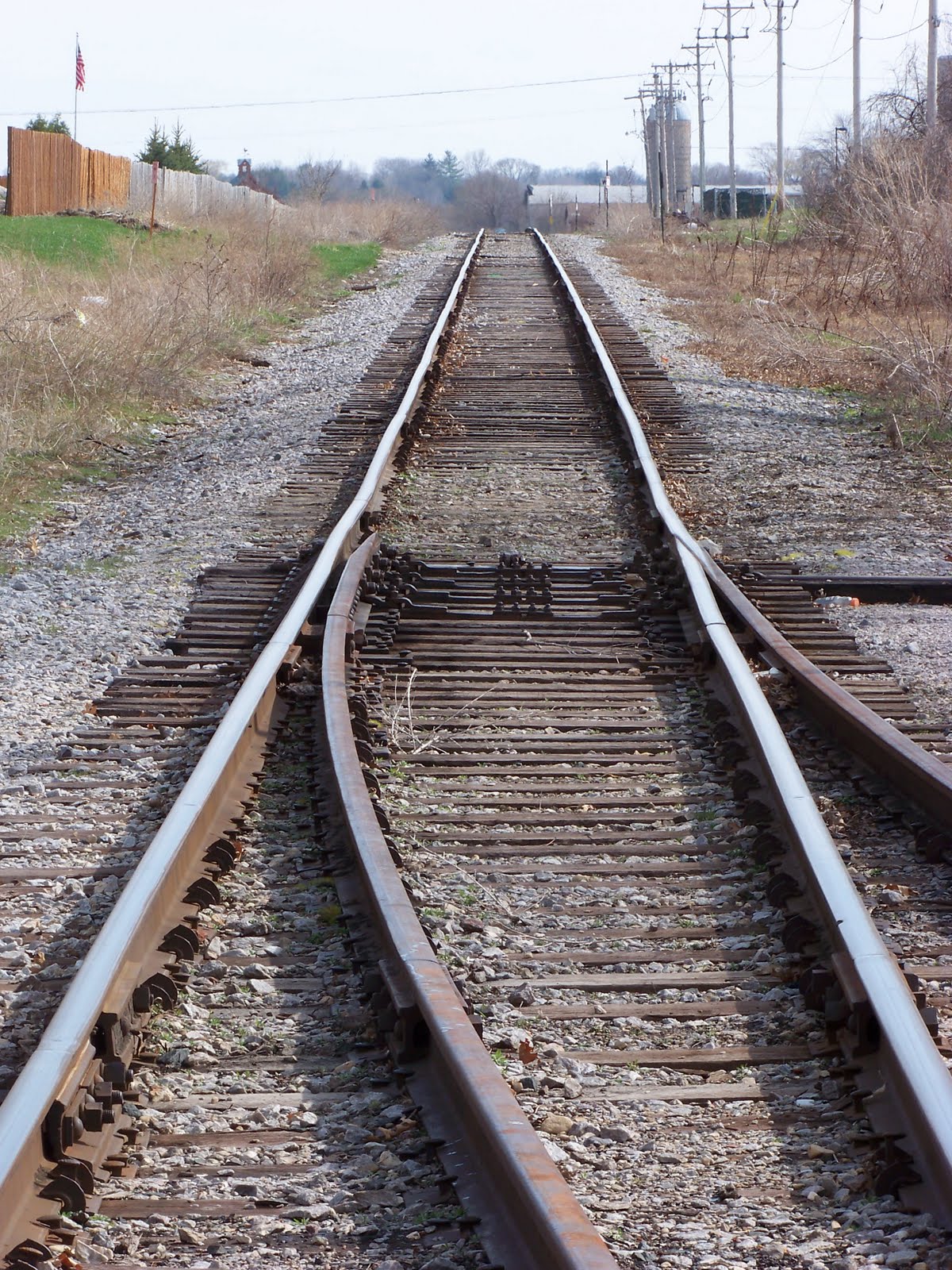
Image: DeForest Tracks (c) 2011 W. Clinton Hotaling