Search This Blog

Showing posts with label retail. Show all posts

04 August 2016

Have studio, will travel.


How I work with a portable studio.

The studio before I got the photo backdrop.
Grey blankets served as a neutral background,
although I often would hang a decorative
Celtic knotwork panel for a portrait.
When I started doing portraiture, I saw a niche in the many events that my history club puts on, and few formal ways to document the effort and comportment of the participants.

We have a regular summer event, Warriors and Warlords or WW, which regularly draws over 600 participants from all over the Midwest, upper Plains and parts of southern Canada. My idea is to have a studio that I can literally set up in the middle of a field, control the light with various methods (which incidentally kept the studio a little cooler than outside--a plus when the Heat Index approaches or passes 100 degrees F!), and photograph my friends in their finery to display on their walls and for their friends via social media. The big plus for many was that each had an 8x10 print of their portrait within an hour at most to take home and put on his or her wall. All this for the low, low price of $40. More goodies were available if they wanted them.

Yes, I'm working cheap here. I expected an average of two sessions per hour when I was open, to amount to a score a day. I never achieved that volume. The most I ever did was eight in one day for a winter event that had a charity component, and nine for the whole four-day run of WW. There were two years at WW that I didn't have any clients! The summer heat and humidity aren't conducive to people wanting to wear layers of finery. I actually had one family rush in and settle down for their portraits, then rush out so they can change to cooler clothes! I actually have better sales during winter events, when people are already showing off their finery and are willing to be posed in a warm, comfortable space.

Such is the adjustment of my business/service model. More winter events.

To offer this service at such a ridiculous price means I have to be creative with my equipment. The most expensive pieces of my set-up were of course my camera and lenses, followed by a robust notebook computer and quality photo printer. I'm a Pentax fan from way back, and have an assortment of compatible manual lenses. I started with a K-01 body, 18-55 mm f4.5 and 50-200 mm f4.5 lenses, Tambon 65" tripod, Toshiba 15" Satellite and HP Photosmart 5220 printer. I later upgraded to a 17" Toshiba Satellite and a Pentax K-3 II body. I found a Manfrotto 100" studio tripod and three-way head in the local Pawn America for $100 and snapped that up.

For lights, I use a 68" dual 500 watt halogen work light tower bounced into a 42" reflecting umbrella for my fill light, two 1000 candlepower LED work lights and two more 1250 CP LED spot lights in hot light fixtures for my main light, all daylight balanced. I use either three colored CFL bulbs in clip lights or another 1000 CP LED daylight flood in a clip light for the backdrop light. My decorative lights and general work lights are all LED. When shooting, I use all of 7 amps, an advantage when you are limited to 15 amps.

The studio itself is a Coleman 10'x 10' canopy with a swing wall, effectively giving me a footprint of 10' x 17' with the wall raised up. I purchased a 40' wind wall set for the canopy, under which I use an assortment of power cords and junctions to redistribute power where I need it.

Lyn admiring her ring. At this point, she'd dropped over 100
pounds from the previous year, and wanted photos to show
  off her new figure.
Sunlight was first controlled with the use of fleece blankets, an outer layer of white to reflect and an inner layer of black to absorb. I've largely traded the white blankets for black-out curtains, to cut down on bulk. You can't argue with the texture of the black polyester fleece when you want a dead-black background, so I kept them. I use a photo backdrop frame that can expand to 10' wide and 10' tall with a 10' x 12' linen mottled grey backdrop. I paid full price for the backdrop and never regretted the cost.

Most of this packs into three tubs (It used to be six!), with four long bundles for the light stand, tripod and backdrop stand. The canopy has its own bag, as well as the walls and backdrop. There is a folding table, a rigger's bag with electrical cable and connections, a bushel bag of spring clips (and that still isn't enough!), folding stools and chairs.

The whole thing takes about an hour and a half to set up outside, a little less inside as I don't have to shield the walls as much.

It does make a satisfying space to work in, and was well worth the time I put into making it.

26 July 2013

The Busy Client

Photo booth ready for customers.
My photo booth was set up in the middle of the merchant area, ready for clients to have their portraits done and printed on site.

In spite of the summer sunshine and heat, I had effectively created a cool cave in the middle of the field.

Alas, business was slow--as in nonexistent. A conflict with another larger event kept many of the event participants away. Few had the funds or interest in getting a portrait done, despite favorable comments about the sample pictures. Even other merchants noted the lack in their sales.

Busker entertains the "crowd"
So I wandered the site, taking personal photos. I enjoyed the ambiance. I checked out the wares of the other merchants. I even bought a few.

Main Pavilion lit up for evening activities
Interesting scissors masquerading as a dagger
Nobody was interested in getting a portrait.

We had a big awarding ceremony on the last night. The local chapter executive (our "Baron") just recently stepped up to the High Seat. Robert, the Baron, never had a portrait done in his finery.

Perfect.

I set up an appointment with Baron Robert for just after the ceremony.

I knew Robert could get distracted, so I came up with a plan to make sure he came to the booth:

Right after the ceremony, I borrowed the Baron's High Seat and lugged it with the help of a friend (It's made of oak and quite heavy.) to the booth and set it up. I made no secret that I did this. Sure enough, Baron Robert strolls in looking for his Seat. He admitted that my kidnapping the Seat was a sure way to make sure he made it to the shoot.

Baron Robert the Stout
We had a good shoot with three very good portraits.

Afterwards, I helped Baron Robert disassemble the Seat and pack it up for transport. It seemed only fair.

Sometimes a little subterfuge can be a good thing.


25 June 2013

The Marks of a Professional

Moonlight over DeForest fog

Ever have the contractor or vendor that is consistently late for meetings or deadlines? Or the client that doesn't know what she wants from your service? How about the designer that delivers the copy master as an unlabeled (not even writing!) bare disk?

Why would you put up with such behavior? Many of us do, because we feel it would be more inconvenient to go to another provider, or in spite of way the work was delivered, it's still very good work. The clueless client may pay you very well (you hope) for the time you take to walk them through deciding what they want and need from you.

Does their value to you make their behavior right? No. Quite simply, you condone and even encourage these things by merely accepting them. On the other hand, some of these things have contractual or real life consequences. A missed deadline for you means you can't get your product into production on time. You don't get paid. Your reputation suffers. In the creative world, a good reputation is golden and gets you jobs. 

Labelled discs are bad enough about straying, an unlabelled one? *shudder* I have hundreds of discs in my work area. Most of them are blank and unburned. I NEVER complete a disc burn without marking it with at least it's title. My clients get discs with full labels on them that include my name and contact information. In fact, all my delivered work has this information. How can business repeat if your client can't find you again?

How not to be a problem vendor

It's real simple. Care about your client. Give a rip about their time and deadlines. 
  • Be on time for meetings, deadlines and work days. 
  • Be ready to do the job: Is your research done? Are your questions ready? Is your notepad (paper or electronic) handy? Do you have your pencil/stylus? Are the batteries charged? Do you have all your equipment ready to set up and use? Are the proofs printed/on the screen?
  • Actively listen to your client. Make sure you understand what they tell you. This way you can usually anticipate their needs, and often offer a novel solution to their situation.
    Setting up for portraits
  • Stay focused on the job while you are there. Wasting the client's time is wasting your time, too. There are other, often little, things you can accomplish as soon as you are done working on your client's project. Don't cheat yourself of that time by wasting it during a job. (I understand if your client or someone assisting you has to complete a task between when you set up and when you do your thing. You might be idle, but often that time is necessary to complete the project.)
  • When you deliver, make sure your product is ready to go away from you. Is it in the form your client can use? Is it packaged to protect the contents? Can your client find you from your packaging or enclosures? Is it attractive?
When you care about your client, you are building a (hopefully) profitable long-term relationship. These relationships tend to be the main source of income in the creative world.

Problem People

Before it gets too far, have the courtesy to ask them (nicely) to meet your expectations. It's just good people skills and good business.
  • "By the way, my client was upset because of the delayed meeting. Please be ready for the next one. It's so and so time at such and such place. Do you need directions?"
  • "It's really hard to estimate the license fee when we don't know how the pictures will be used." or "How big are the walls you want to put these on? That will determine the size of the prints I will deliver. Do you want me to go over there and measure?"
  • "Hey, that brochure layout was great! I'm glad I got it loaded right away, because the disc slipped off the table and got scratched. I have this great source for the sleeves I use. Do you want to try them?"
 Sometimes you just have to fire the people that cause you too much grief. That includes clients as well.
  • "I'm sorry. I can't afford to work with you anymore."
Professionalism is a choice. It says you care enough about your business and clients to make the effort. That effort is expected and sometimes rewarded.

Both images are under the copyright of W. Clinton Hotaling.

03 May 2011

The Nature of Business

I have a day job, since I'm just getting started in the photography business and still need to eat and keep a roof over my head. We can't afford to live on just my or my wife's income by themselves, so I need to keep working there. I'm also realistic about my expectations; my wife even more so. I like to dream a bit (and spend money on what she calls "toys"), while she reigns in my fantasies with conditions for making the purchases. There's a little friction here, but this arrangement keeps our debts manageable.
For example: While I'm well aware that good photography is 95% the photographer and 5% the equipment, I do want to upgrade my camera with the idea of getting the ability to compete or simply having the respect of my clients. I have a perfectly respectable film SLR camera, which is great for art photography, and I have usable digital cameras that can cover about 90% of the situations I envision using a camera. The problem with the film camera is turnaround time for the clients, something that digital processes have shortened considerably. Turnaround time for film was made worse by the dearth of local film processors in my area. I can still get them done, but not the same day anymore. My old processor now takes a week or more just to bring me back the negatives! For my own projects that isn't an issue since I take time to scan the negatives and manipulate them as I need to, and I seldom have hard deadlines for my own projects. Most clients aren't willing to wait a week for the finished product, much less proofs.
The DSLR in question will run me $1400-$1700, and that's just the body. I can get a lower quality one for around $900 (It's the immediate predecessor.), but the upgraded one shows more longevity in usability. Also with a good unit, I'll be able to turn around projects often the same or next day for a client. I can even shoot high definition video. Fortunately, I have a good set of lenses that will fit this body, which suit my style of shooting. (I prefer manual focus over autofocus because I've found the autofocus will often enough home in on something that isn't my subject. It's one less thing to fight.)  Having the lenses already will save me more money than the camera itself in the long run. Most professionals will say, "It's a good investment, why haven't you bought it already?"
Good question. The answer is the condition for purchase compromised between me and my wife: I must have a job in the photography field or I need it for a class. And I'd better REALLY need it for that class. Understand that we're self-financing this business plan, and any money I spend is to be relevant in the moment. So, it's good that my wife keeps me in check. Less debt and fewer expensive dust collecters that way.
So, back to the day job. Needless to say, it isn't as a photographer, photographer's assistant, nor photojournalist. Like most creative types (I do include myself in that select group.), I chafe a bit from time to time working for a corporation even though I own stock in that corporation. The stress is getting worse lately, with communication conflicts with my supervisor and staff reductions and added responsibilities. I understand that a great many companies are having to work this way, but with customer service oriented businesses like retail stores, you need enough people to be there for the customers, not just physically but without distractions as well. I can go on and on about balancing the needs of your customers with the abilities of your employees and the profits your executives and investors make, but I don't have time to write that tome.
Let's just say that the stress is giving me impetus to jump-start my own business.
I also realize that working as a photographer can be a difficult way to make not very much money. Ah, but there is the satisfaction of the well-crafted image. There is also the coolness factor of the positive feedback when I show my product. That helps pay my emotional bank account. I know I'll never be financially wealthy, but the riches of a good body of work, and the satisfaction of creation goes a long, long way.
For a while at least, I'll keep the day job. When business picks up, I'll go to part time with it.
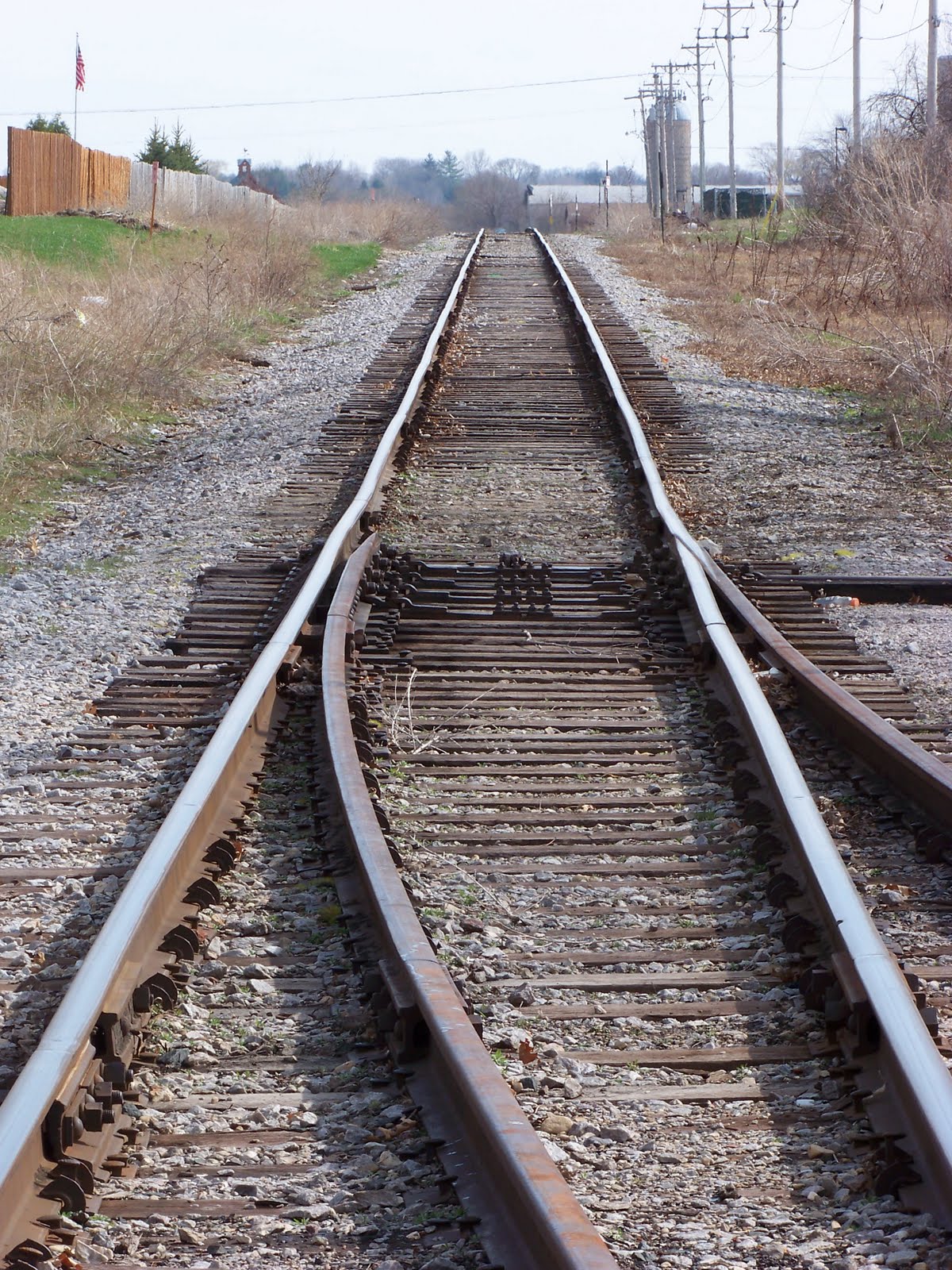
Image: DeForest Tracks (c) 2011 W. Clinton Hotaling